Rocky had slapped a quarantine chamber together by the time the transport pod returned to Mari’s hangar. With their limited supply of xenonite, it wasn’t all that big—just barely enough to fit Simon’s body, lying across a stretcher, below the spindly arms of the medical robot from Grace’s old ship. Grace had managed to tourniquet Simon’s arm aboard the pod; the robot had clamped the severed blood vessels and revised the amputation site, stitching muscle and skin into place to properly cover the stump.
“Amputation” was how Grace was choosing to think about it, rather than dwell on the memory of frantically hacking someone’s arm off with a hatchet.
Scans and tests had revealed some kind of microorganism infesting Simon’s body. With the equipment the Peacekeepers had left behind, Grace had synthesised an antiprotozoal that seemed to be working. It would also kill off the translator microbes in his system; they’d have to re-inject him once the medication ran its course. Fortunately, the DRDs seemed to have a ready supply.
It would be better if Simon could understand everyone else on the ship when he woke up. If he woke up.
The Peacekeepers’ medical supplies had included a few units of sebacean blood; they’d given Simon a transfusion, and his blood volume was back up to safe levels, but he was still unconscious.
Grace had pulled up everything he could find in Mari’s databanks about sebacean heat delirium. Apparently, if it went on long enough, it advanced to a terminal stage that amounted to total brain death—the Peacekeepers called it “the Living Death.” But Simon’s brain looked fine on the scans—or, at least, fine by human standards.
Maybe, between the heat exhaustion and the blood loss and the microbial infection and the trauma of getting his arm chopped off with a hatchet, he just had a lot to sleep off.
Grace had done everything he could. All he had left to do was worry, and wonder how the heck Simon wound up on that leviathan in the first place.
They’d herded Simon into the prison transport at gunpoint and sealed him inside, alone.
He hadn’t been given much in the way of equipment: just a hatchet and a hand lamp. Even then, they weren’t taking any chances; the rear compartment of the transport was sectioned off, with no access to the cockpit. There weren’t any viewports, and only a single, dim light to see by.
They could’ve at least given him back his knife. The empty sheath hung from the mantle of Simon’s hood; he held it loosely in one hand, thumb rubbing mindlessly over hard leather and metal rivets, over and over again.
There was a crackle from the comm attached to his sleeve, and a woman said, “How are you doing back there, Convict?” Simon recognised the voice; it belonged to the captain of the command carrier that had brought him here. “Ready to do some good for a change?”
“Yeah,” Simon replied bitterly, not bothering to keep the impatience out of his tone. “Let’s get this done.”
The Peacekeepers had come to Simon in his cell and told him they had a mission for him—a chance to commute his sentence. One job, and he’d be free.
It hadn’t taken much thought before Simon agreed; as a convicted terrorist, there was no other way he’d ever get out of that cell. He couldn’t go home to Eden—wouldn’t want to, even if he were still welcome there—but if he could hitch a ride into the Uncharted Territories, he had a chance of living out his days in something like peace.
A jolt went through the floor of the transport as it landed. A minute or so passed in silence, and then there was a hiss from the rear compartment’s hatch as it rolled open. Outside was nothing but darkness.
“Out you get, Convict.”
With halting movements, Simon stepped out of the transport. His boots rang hollowly on the floor—it was metal. He was aboard a station, or a ship.
He switched on the hand lamp and held it overhead. The beam wasn’t strong or particularly wide; the circle of light it threw was absolutely tiny by the time it landed on the wall ahead.
Simon was in some kind of hangar; the space was enormous, bulkheads curving around and overhead like the ribcage of some enormous creature. And it was warm—warmer than either his cell or the transport had been. He pushed his hood back and unwrapped his hands.
He couldn’t see into the cockpit of the transport, so instead raised the comm to his mouth. “Is this a leviathan?”
“One of ours,” the captain confirmed. “We lost contact a few days ago. Scout patrol found it drifting.”
“What happened?”
“That’s what we want you to find out,” said the captain, faintly mocking. “Start with the lab. It should be in the maintenance bay, just off the transport hangar.”
Simon set off for the inner doors, at the far end of the hangar. They were thick and heavy and remained stubbornly closed as he approached.
Shining the light along the bulkhead, he found a control panel. The interface was dead, so he used the blade of the hatchet to pry off the cover; inside was a strange mix of wiring and what almost looked like living tissue, stringy and translucent. One cluster of tissue dominated the whole mess; after a moment’s contemplation, Simon detached one of the smaller wires and pressed the live end to the central node.
It convulsed, and there was a thunk from somewhere inside the bulkhead. The doors cracked open enough for Simon to squeeze through.
“Close the inner doors,” the captain ordered.
“What? Why?”
“Can’t depressurise the hangar with them open,” she replied, as if talking to an idiot.
“You’re leaving?” Simon spun back toward the hangar, but couldn’t see the transport from here. “How am I supposed to get back?”
“We’ll come and get you once your mission is complete.” The captain sounded annoyed. “Now do as you’re told and close the inner doors.”
With some reluctance, Simon found a corresponding panel on the inner side of the wall and tried the same override. The doors slammed shut.
There was a hiss from the other side as the hangar depressurised, fading off into silence. He felt the ship rumble under his feet as the outer doors opened, but the hangar was now a vacuum; he couldn’t hear the transport depart, although he was sure after a few moments that it was gone.
Simon moved further into the maintenance bay. Workbenches were arranged in neat rows throughout the space, various pieces of equipment scattered across their surface. Of the crew who worked here, there was no sign; it looked as though they’d all been mid-experiment when they were interrupted. Simon found a console among the equipment, but it was unresponsive; he tapped at the controls, to no avail.
Something wet dripped onto his hand.
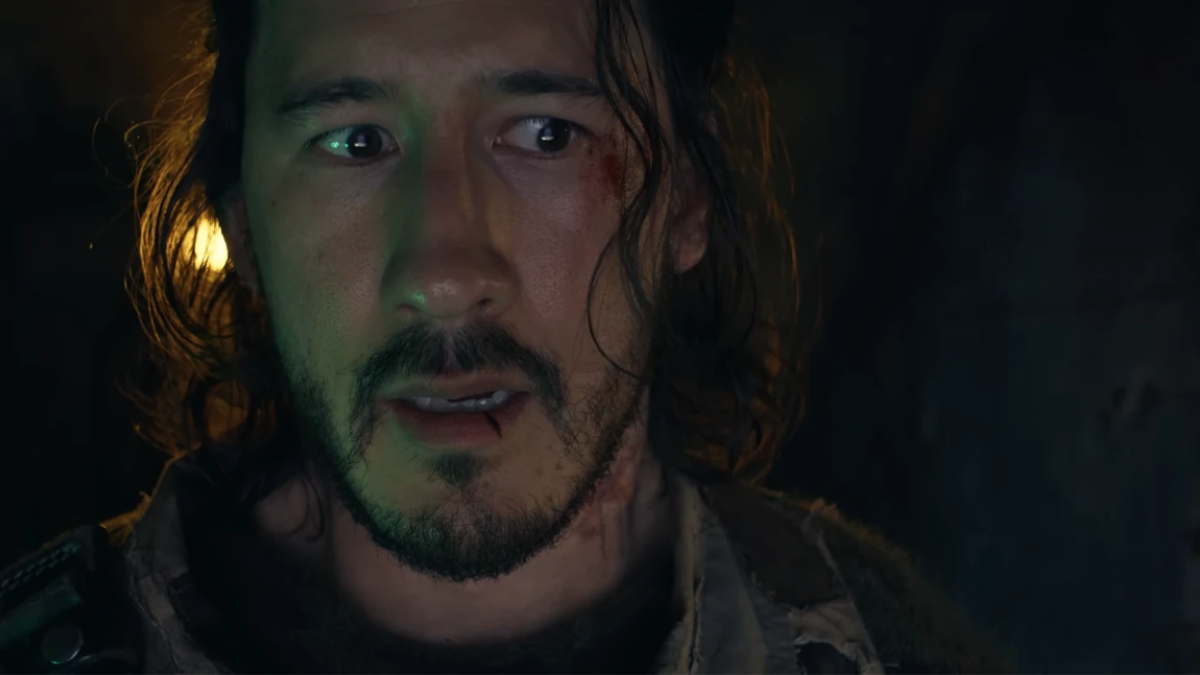
Simon froze. Slowly, he raised the lamp until the light shone onto his own outstretched arm. There was a smear of red across his knuckles.
It looked like blood.
He aimed the light upward. The actual ceiling of the maintenance bay was too high to see properly, but he could make out the edges of curved struts arcing overhead. Clinging to the underside of one was a string of viscous red fluid, dripping onto the floor.
“Convict?” the captain broke in, impatient. “Have you reached the lab yet?”
“The leviathan’s bleeding,” Simon replied, unthinking. “If they even bleed. I don’t—some of it dripped on my hand.”
“You got it on you?” Her voice was sharp and intent. “It touched your skin?”
“Yeah.” Simon felt, even as he said it, that this was the wrong answer. “None of the equipment here is working. I think the power’s out.”
“The leviathan’s pilot can activate the backup systems,” the captain said. “See if you can find its den. It’ll be near the centre of the ship.”
The door leading from the maintenance bay into the rest of the ship was closed, but the mechanism that kept it locked appeared to be nonfunctional. With a firm shove, it swivelled open enough for Simon to edge past. The corridors on the other side were wide, but featureless; one led deeper into the ship, so that was the one Simon followed.
The insides of the leviathan were a winding maze—like the branches of a tree, or the blood vessels inside a body. As Simon ventured deeper, the beam of his lamp found a door, hanging open. Behind it was a small room—crew quarters. There was a bed, and not much else.
He passed other, similar rooms as he went on; there had clearly been a large crew aboard the leviathan, one that was now gone. Simon could breathe, so life support hadn’t failed. But even if something had managed to kill the whole crew, wouldn’t there be bodies?
Where was everyone?
Sweat beaded on Simon’s forehead, trickling down his skin beneath his clothes, pooling at the small of his back. It only got hotter the further in he went. There was more blood—or whatever it was—leaching from the walls, spreading in thick pools across the floors. In some places it had clotted, or—or something, forming slick, fleshy clumps.
There was a faint noise, just beyond the range of Simon’s hearing—like a conversation in the next room, too quiet to pick out individual words.
“Hey,” he growled, “can you cut the chatter on the comm?”
“What?”
“Whoever’s talking in the background. It’s distracting.”
“No one’s talking. Just me, now.”
Frell. That could only mean one thing. “It’s really hot in here.”
“Ah,” the captain said, understanding immediately.
Simon rubbed his sleeve across his forehead, wiping away the sweat dripping into his eyes. There was a slight tremor in his fingers. “I won’t be any use to you if my brain burns up.”
“You have at least a few hours before that happens,” the captain assured him. “All the more reason to move your ass.”
After a few more twists and turns, Simon reached another door—this one larger than the others. He shouldered it open to find a dark, cavernous chamber. The beam from his lamp passed over an array of walkways, extending from the edges of the room to meet in the middle.
Simon ventured out onto one of the walkways. There weren’t any railings, and when he shone his light onto the floor, the edge dropped off into open air and darkness.
He stepped more carefully, after that.
Up ahead, where the walkways converged, Simon caught a few glimpses of something rising up from the floor. As he got closer, his lamp illuminated a large console, ringing around the room’s central platform.
Then he saw what was behind the console, and he stopped in his tracks.
Within the circle of the pilot’s station was an immense pillar of … something, stretching up into the ceiling. It looked like the same substance as the growths on the walls—slick, featureless, pulsing meat. Of the leviathan’s pilot, there was no sign—until Simon spotted a long, insectoid arm emerging from the fleshy mass, still reaching out toward the nearest control panel.
There was a sound from behind him—a low, rasping whisper.
Simon didn’t move. His heart pounded in his chest as he slowly reached for the hatchet on his belt. In one motion, as his fingers wrapped around the handle, he spun and raised the hatchet to ward of whatever was behind him.
Except there was nothing there.
Simon shuddered and wiped his face again before bringing the comm to his mouth. “Hey, uh … I’m in the den. I think the pilot’s dead.” He eyed the column of twisted flesh; he certainly hoped they were dead.
“Okay,” the captain replied. “You’ll have to switch to backup power manually, then.”
Simon hopped over the console, careful to avoid the outstretched arm, and studied the controls for a moment before hitting a few in quick succession. Rows of lights along the edges of the walkways flickered into being, and there was a hum from deeper inside the ship.
“Convict, what’s going on? We just detected an energy surge aboard the leviathan.”
“I’d hope you did,” Simon shot back. “I turned the power back on.”
“… I haven’t given you the sequence for the pilot’s console yet.”
“I didn’t need it.” A weight settled in Simon’s gut as the words came out of his mouth. “I just … knew.”
The comm was quiet for a long time, and Simon couldn’t shake the feeling he’d said something wrong.
“See if you can reach the command,” the captain finally said. “From there, you should be able to send us the research data from the lab.”
Simon took a steadying breath. “And then we’re done, right?”
“… Yeah. Then you’re done.”
Simon climbed back over the pilot’s console and made his way out of the den, grateful there was now enough light for him to see the edges of the walkways. The corridors outside were still dark; evidently, whatever the leviathan used as a backup power source could only handle so much.
He guessed the command would be on one of the higher tiers, and took the next corridor that led upward. The fleshy growths on the walls were larger up here, and closer together. It hadn’t gotten any cooler; his hands were shaking now, making it difficult to hold the light steady.
A voice in his ear whispered, “Simon?”
Simon flinched, heart pounding as he ducked around the nearest corner. He couldn’t stop the panicked rasp of his breathing, covering his mouth with his free hand to muffle the sound.
When nothing lunged after him, he carefully edged back the way he’d come and peeked around the corner.
The corridor was empty. He was alone.
The heat delirium was getting worse; he had to keep moving.
As expected, Simon found the command centre on one of the leviathan’s upper tiers. The door was already open, and he took a few careful steps into the room, shining his light in a wide arc. There were more of those strange growths in here, clustered in greater density than anywhere else on the ship.
He could see the Peacekeepers’ command carrier, massive and intimidating, through the front viewport. It had matched velocity with the leviathan but was keeping its distance maybe fifty metras away.
The operations console was working, but the interface was sluggish, running slowly on reduced power. From here, though, he could access the ship’s databanks—including the reports from the lab in the maintenance bay. They were a mess of charts and numbers Simon couldn’t parse at first glance, but that wasn’t his problem; he just had to send it back to the carrier and let them handle it.
“I have the data from the lab,” Simon reported into his comm. “Sending it over now.”
The tremor in his hands was debilitating, now, but he managed to pull up the console’s transfer utility and send a connection request to the command carrier. It was accepted almost immediately.
“We’re receiving,” the captain confirmed. “Stand by.”
He’d be out of here soon. Simon let out a breath of relief, bringing his other hand up to rest against the console—
And went very still.
The back of his left hand, where the blood had touched him, was red and inflamed. Livid veins crawled under his skin, stretching up toward his wrist. There was something stuck to his knuckles, a lump of something dark and wet; Simon tried to brush it loose, but it stuck fast. He dug his nail in to peel it off, and pain lanced up his arm; he quickly pulled away.
It wasn’t on his hand. It was his hand. Something was growing out of him.
There was a warbling noise from the console.
“Hey,” Simon rasped into the comm. “Hey, the transfer’s finished. I can leave now, right?”
“I said stand by,” the captain barked at him. Then, more muffled—as if she’d turned away from the comm—she said, “Let me see.”
There was a muttered conversation that Simon couldn’t fully hear, but he made out the word “bioweapon.” Another voice, not the captain’s, said, “One of the conscripts must’ve—”
The chatter from the comm descended into incoherent clamour. It was all around him, dozens of voices, whispering, crying, screaming—
“Shut up!” he roared.
Everything went quiet. Stunned silence echoed down the comm line.
“Listen to me,” Simon pleaded. “I want out of here. Do you understand? It’s too hot and there’s something growing on the walls—something alive—”
“Right,” the captain interrupted, with horrible certainty. “That must be what happened to the crew.”
“What?” Simon’s eyes were drawn, inexorably, to the growth on his hand. “What do you mean?”
“It’s in the logs,” the captain explained. “One of the scientists conscripted onto the project was working on something in secret. Some kind of biological agent.”
“And …” Simon swallowed, his mouth dry. “It got loose?”
“Or was set loose.” The captain let out a weary sigh. “It assimilates living tissue. Those growths on the walls—they’re the biomass of everyone who was aboard at the time. And now it looks like the leviathan is being assimilated, too.”
The voices. That was what he’d been hearing—the voices of all those people, consumed and suffering—
“Get me out,” Simon begged, voice rattling. “We had a deal. I’ve done enough. You have to get me out.”
“I can’t do that,” the captain replied. “You’ve already come into contact with the organism. You’re irreversibly contaminated.”
“I’m still alive,” Simon insisted. “I’m alive, I’m not—I’m not some lump of meat stuck to the walls. Not yet. There has to be some way to stop it—”
“If I brought you back, you could infect the rest of my crew.” There was something like regret in the captain’s voice. “I can’t risk their lives like that. I’m sorry.”
“Don’t leave me here, please—”
The comm went dead. There was movement through the viewport; the command carrier was pulling away.
“No, no, no,” Simon rasped into the comm. “Please come back. Please. Don’t leave me here. I want to live. I just want to live.”
There was a hot, dull ache in his arm. The growth on his hand had spread to his wrist, tendrils reaching up his forearm.
A voice in his ear whispered, “They knew.”
They knew, when they came to his cell. They knew there was something dangerous on this ship. They knew that anyone they sent here couldn’t come back. They’d promised Simon his freedom, and lied through their teeth.
They’d sent him here to die.
“It’s what you deserve.”
He didn’t want to die.
Simon huddled on the floor, cringing away from the muttering growths on the walls, holding the comm to his mouth as he cursed, pleaded, cried for anyone to help him for what felt like eternity, until his throat felt like it was full of razor blades.
“Nobody’s coming. You belong to us, now.”
And then, up out of the dark, a voice—a new voice—said, “Uh, hello?”
Leave a Reply