Grace remembered Earth more clearly in his sleep than he did while he was awake.
He walked along the beaches in San Francisco, or taught in his classroom. He worked in the lab aboard the Petrova Task Force’s appropriated aircraft carrier. He sat at the bar in a tiny break room and watched the world’s brightest minds sing terrible karaoke.
He was in a conference room. It was quiet. Yao sat at the other side of the table, with Ilyukhina. There was supposed to be a third, but he was … missing, for some reason. And Stratt was there.
They were all looking at him. He didn’t want them to be looking at him.
Grace opened his eyes.
For a few disorienting moments, the room around him was completely alien. The bulkheads curved overhead in a way that could only be described as organic. There was a low, constant hum in the air. Everything was shades of bronze and brass.
“Grace awake.”
He rolled onto his side, peering at the half of the room that had been walled off with transparent xenonite. Of his roommate’s five spidery legs, three were tucked beneath him while two fiddled with some kind of device between his clawed hands.
“Morning, Rocky,” Grace mumbled.
“Grace twitch in sleep.”
“Yeah.” Grace rolled onto his back again. “I was dreaming.”
Rocky’s dismissive hum didn’t quite translate. Grace had tried to explain dreams a few times now, but Rocky had expressed a certain skepticism toward the concept.
Eridians didn’t dream. They just switched off. The idea was a little terrifying, but Rocky probably thought it was terrifying to hallucinate for long periods while completely paralyzed.
“Dr. Grace?” said a voice from the floor. Grace’s comm was still attached to the shirt he’d stripped off last night.
Grace leaned over the edge of the bed and pawed around until he managed to unclip the comm from his dirty laundry and bring it within range of his mouth. “Yeah, Pilot?”
“We have nearly arrived at our destination. You and Rocky are needed on command.”
By now, Grace didn’t find it awkward to get dressed in front of Rocky; the guy could hear through his clothes anyway, so there wasn’t much modesty he had left to preserve. Rocky himself didn’t wear anything except, occasionally, his toolbelt; either Eridians didn’t do clothes, or Rocky was kind of a freak. No way to know which.
Pilot’s tone hadn’t implied an emergency, so Grace took a few extra minutes to freshen up. Of all the things that had been recovered from his old ship, his toothbrush somehow hadn’t been among them; his only remaining option was a dentic. He wasn’t sure he’d ever get used to sticking a little white leech in his mouth to clean his teeth, although it was hard to argue with the results.
Rocky’s transport ball tumbled noisily at Grace’s side as they made their way up to the command centre. It was a big ship, and Rocky had a limited amount of the chemicals he used to make xenonite; they’d walled off his workshop in the maintenance bay and one half of the quarters he shared with Grace, but if Rocky wanted to go anywhere else, he had to use the ball.
A pair of DRDs zipped along the floor, coming the other way, and Grace quickly hopped aside to avoid tripping. The little drones seemed to love getting underfoot, although Grace couldn’t help noting that none of them ever got in Rocky’s way.
Although Rocky weighed nearly three hundred pounds. If one of the DRDs ever did wander into his path, it risked getting rolled over and crushed.
A huge, irregularly ovoid door swiveled open as Grace and Rocky approached it. Beyond lay the command; through the front viewport, Grace could see a yellow main sequence star not unlike Earth’s sun.
The clamshell-shaped emitter off to one side of the room lit up, projecting an image of Pilot’s face. “Scans confirm this star is also infected with Astrophage,” she informed them. “Historical data indicates its output has dimmed by nearly ten percent. Fortunately, none of the planets in this system are inhabited.”
It was still weird to hear that young, female, crisply British voice come out of a crab-squid alien that lived in the deepest reaches of the ship. Then again, that wasn’t Pilot’s real voice—it was just what the translator microbes colonizing Grace’s brain stem made her sound like. Why his brain had made that particular association was anyone’s guess.
“Anyone else around?” Grace asked.
“Yes,” Pilot replied. “One other vessel detected, in orbit around the star.”
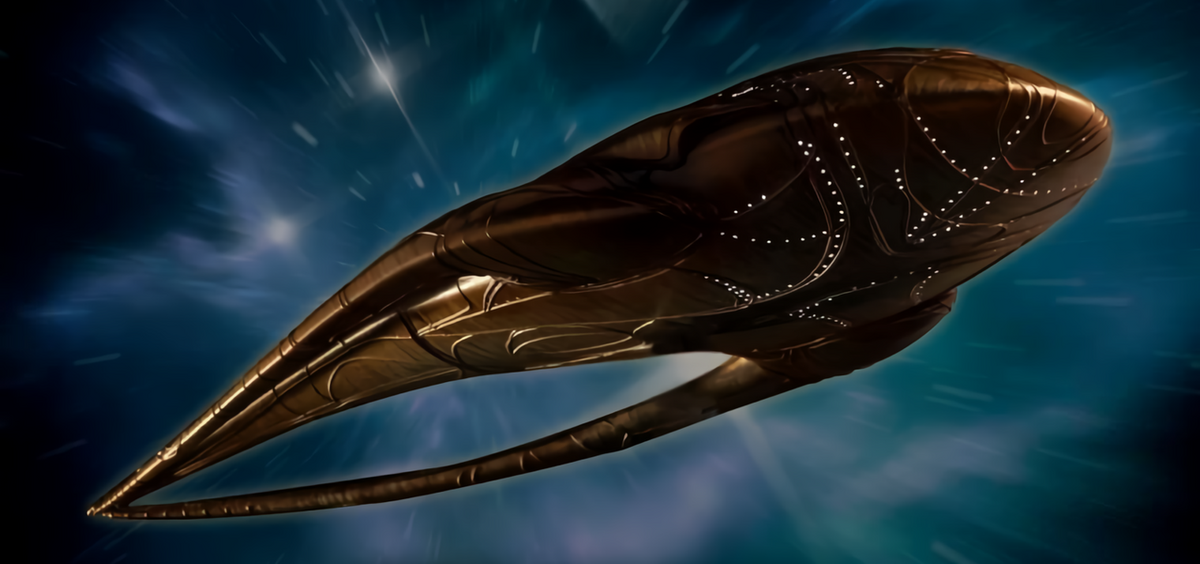
The strategy table in the middle of the room activated, and a monochrome, three-dimensional hologram appeared above its surface. Modeled there in miniature was an oblong shape, tapered more sharply toward one end—like a slightly flattened teardrop, or a child’s drawing of a whale.
It looked strangely similar to the vessel they were on right now. “Is that another leviathan?”
Grace only got about halfway through the sentence before the ship lurched under his feet. He grabbed onto the nearest console for balance; Rocky slid across the floor, shrieking untranslatable profanities as his ball collided with the rear bulkhead.
They were accelerating toward the other ship, so fast that the systems managing their inertia weren’t quite up to the task.
“Apologies,” Pilot said, a little flustered. “It has been some time since Mari last encountered another of her kind. She is … excited.”
As cool as Grace found the whole “living ship” concept, it was kind of spooky to be inside something so much bigger than he was that had a mind of its own.
“The other leviathan appears to be severely damaged,” Pilot reported. “And it’s wearing a control collar.”
“Is Peacekeeper ship.” Rocky tensed inside his ball, legs braced around him. “Peacekeepers here, question?”
“I can detect no other vessels nearby,” Pilot assured him. “This leviathan seems to be abandoned—perhaps due to its injuries.” After a moment’s examination, she added, “The control collar is also damaged.”
“Can’t Mari just ask the other leviathan what’s going on?” Grace asked.
“She is trying,” Pilot replied, “but having little success. The other leviathan’s transmissions are proving difficult to parse. There is … interference. Too many voices at once.” She made a noise of interest. “I am, however, picking up another transmission on a separate band.”
Grace tightened his grip on the console—which turned out to be the operations console—and pulled himself upright. “Can you put it through?”
There was a brief, squeaking noise of acknowledgment from the console.
“—back.” The voice on the comm was low, rasping, exhausted. “Please come back. Don’t leave me here. I just want to live, please …”
Grace cleared his throat. “Uh, hello?”
The channel went quiet.
“Are you okay?” Grace asked. “Do you need help?”
After a few seconds, the voice on the other end of the line said, “Are you real?”
Grace wasn’t sure what to say to that, besides, “Yes?”
The voice didn’t seem convinced. “Who are you?”
“I’m Dr. Ryland Grace.” When that was met with more silence, Grace asked, “What’s your name?”
“… Simon.”
“Simon,” Grace repeated. Odd that the name sounded like one from Earth, but maybe that was the translator microbes at work. Or maybe, in all the vastness of the universe, there were only so many ways to put two syllables together. “We’re on our way to meet your ship. I guess we can help with repairs, or—?”
“Get me out,” Simon interrupted, desperate and ragged. “Please, please, just … get me out of here.”
“Uh … yeah, I think we can do that.” Grace quickly muted the channel and turned to Pilot’s projector. “Can we do that?”
“Leviathans are incapable of docking ship-to-ship,” Pilot replied. “You would need to take a transport pod.”
“Grace piloting bad,” Rocky pointed out.
Grace didn’t have the grounds to argue. He’d been in one of Mari’s transport pods exactly once, to check out some abrasions left behind after they got her control collar off. He’d barely managed to get the pod oriented in the right direction; any piloting more complex than that was beyond him.
“The access codes we used to free Mari from the Peacekeepers should also work on the other leviathan’s control collar,” Pilot offered. “I can remotely open its transport hangar and activate the docking web. All you would need to do is maneuver on a direct course until you’re in range.”
Fly in a straight line. Grace could do that. Probably.
He unmuted the channel. “Hey, Simon? Sit tight. We’re coming to get you.”
A long moment passed in complete silence, and Grace had begun to worry that the message hadn’t gone through when Simon finally rasped, “Don’t let it touch your skin.”
Compared to Mari’s immense size, the transport pod wasn’t very big; there was just enough room for two seats up in the cockpit, plus a small cargo area in the back.
Grace sat alone at the controls. Rocky had stayed aboard Mari; while he didn’t exactly have to breathe, he did need to vent excess heat through his carapace—and in an enclosed space like his ball, that heat built up over time. It just wasn’t practical or safe for him to venture too far from the ship.
As Grace approached the other leviathan, the pod lurched slightly as an invisible force took hold of it. That was the docking web; Grace lifted his hands from the controls, letting the web steer the pod toward the massive doors of the transport hangar. The doors slid open, and the pod was set gently on the floor.
Once the doors were closed again and the hangar repressurized, Grace opened the hatch and stepped outside.
He hadn’t been sure what Simon meant by “it,” and Simon himself wasn’t too clear on the matter, so Grace had hedged his bets and put on his EVA suit. The soft, ambient glow that illuminated Mari’s interior was absent here; the hangar was pitch black, and Grace only had the lamp on his helmet to see by. He fiddled with the comm in his suit, tuning it to the frequency Simon had been transmitting on.
“—wasn’t part of the plan.” Simon’s voice was low and quiet, muttering to himself. “They wouldn’t listen. I tried to stop it—I didn’t want—”
“Simon?”
Simon’s mumbling cut off with a sharp inhale. “Is … is this … now?”
“Uh … yeah,” Grace assured him. “Yeah, it’s now.” When no further questions were forthcoming, he added, “I’m aboard your ship. Where should I meet you?”
“I … I’m in the command.”
“Okay.” According to Pilot, no two leviathans were exactly alike on the inside—but the command centre would almost certainly be at the front of the ship, on one of the upper tiers. “I’m on the way. Be there soon.”
As Grace moved to switch off the comm, though, Simon’s voice returned: “Can … can you just keep talking to me?”
“Yeah.” The desperation in Simon’s voice tugged at something in Grace’s chest. “Yeah, of course. What do you want to talk about?”
“I don’t know. Anything.”
“Okay. Uh …” Unfortunately, the first thing that came to mind was, “Did you know Phantom of the Opera on Broadway had basically the same orchestra for, like, thirty years?”
“… What?”
Oh, good. Simon was so baffled he’d forgotten to be terrified.
“Yeah, I mean … if you’re a classical musician in the back half of the twentieth century and you land a stable gig, you’re not gonna quit, right?” Grace passed through the hangar’s inner door, into the maintenance bay. There was some kind of lab in here—one pretty similar to the lab the Peacekeepers had set up on Mari. “So it was all the same people, every night, for the whole run. Over ten thousand shows.”
He was panting a little; the EVA suit was intended for use in zero-g. Leviathans had artificial gravity thanks to something Pilot called “gravity bladders,” and upon being told this, Grace had immediately decided not to pursue a full explanation of what that meant.
Point was, the suit was heavy.
“Apparently they all hated each other, too.” Grace exited out of the maintenance bay into the maze of corridors inside the leviathan. “Like, there’s no way that wouldn’t make you a little crazy. All the same songs, night after night, and there’s a hundred other people in the same boat. It’s like one of those existentialist plays. ‘Hell is other people,’ you know?”
“No,” Simon said, his voice distant. “I don’t.”
Grace checked the wrist monitor on his suit. Atmospheric pressure was holding steady, but exterior temperature read as nearly forty degrees celsius. That was hot. “Palm Springs in August” hot. As he watched, it ticked up another degree.
When he looked back up ahead, his helmet lamp caught a glimpse of something dark and thick and wet. He turned the light on it; there was some kind of viscous secretion oozing from the bulkhead, dripping down to pool on the floor. It was a deep, rich red.
“Simon?” Grace said. “I’ll be right back, okay? I need to check in with somebody.”
“… Okay,” Simon replied. There was a panicked edge to his voice.
Grace switched to Mari’s comm channel. “Pilot, do leviathans bleed?”
“Not as such,” Pilot replied, clearly put off by the question. “As bio-mechanoids, they use certain fluids to circulate energy and serve other functions—but those are not ‘blood’ in the way you would understand it.”
“I’m seeing a red fluid on the walls in here,” Grace explained. “And it’s really hot.”
“It’s possible the other leviathan is suffering from an infection,” Pilot offered. “That would explain the fever, and the … unusual secretions.”
“Right.” Grace switched over to Simon’s channel again. “Okay, I’m back.”
Silence.
“… Simon?”
A shuddering breath came down the channel, settling into ragged, pained breathing. “It hurts.”
Right. Time to pick up the pace.
The further into the ship Grace went, the more of that blood-like stuff he saw. Some of it had congealed into large, fleshy patches—gathering in the corners first, then spreading out in a carpet across the adjoining flat surfaces. Like moss, but made of meat.
It throbbed, slick and steady and regular, like there was a pulse going through it.
Grace found the command where he’d expected it to be. The layout was the same as on Mari: viewport up front, piloting and operations consoles, and even a little projector like the one Pilot used to talk to them.
At the center of the room, huddled as far from any of the walls as possible, was a person. He was curled up in the fetal position, arms wrapped around his knees, but from here Grace could guess at a familiar body configuration: bilaterally symmetrical, two arms, two legs, one head.
“Simon?” Grace guessed.
The huddled figure flinched and looked up, eyes widening at the sight of Grace. He seemed more or less human, his long hair hanging limply around his face, sticking to skin damp with sweat. He froze for a moment, then scrambled back along the floor, one hand snatching up a hatchet holstered at his belt.
“Whoa, whoa!” Grace took a step back and raised his hands. “It’s just me. It’s Grace.”
Simon’s only answer was a stare of stark disbelief.
Grace moved forward again and crouched as best he could in the EVA suit, bringing his eyeline down to Simon’s Simon stayed where he was, still staring, chest rising and falling in quick, shallow breaths.
Tuning his comm back to Mari’s channel, Grace said, “Hey, Pilot? I found Simon. He looks like, uh … whatever you said the Peacekeepers are.”
“Sebacean,” Pilot supplied.
“Peacekeeper.” Rocky’s voice was sharp with distrust. “Simon is Peacekeeper, question?”
The Peacekeepers that Grace had met all looked a particular way: military posture buttoned up in dark, squared-off uniforms, with a particular contemptuous glare. Simon didn’t much resemble them; for one thing, the clothes he was wearing weren’t much better than rags, layered up to compensate for all the holes and missing patches. The effectiveness of this technique was reduced by the fact that he’d shed a few layers in the heat.
“Relax, buddy,” Grace said. “Pretty sure this guy’s not a Peacekeeper.”
“Not a Peacekeeper,” Simon agreed, shaking his head. His eyes were glassy. “Mom promised. Never a Peacekeeper.”
“He seems, uh …” Grace struggled to find a polite phrasing, “… out of it.”
“He is likely experiencing heat delirium,” Pilot suggested.
“Is that what it sounds like?”
“Yes. Sebaceans lack the ability to regulate their body temperatures in extreme conditions. As they overheat, their higher brain functions become impaired.”
Simon reached out to touch the visor of Grace’s helmet. Trembling, sweaty fingers slipped clumsily across the plastic. There was something on his arm—some kind of growth, clustered on the back of his left hand, creeping steadily up his forearm.
It looked an awful lot like the stuff on the walls. Grace scanned the room; the lamp on his helmet revealed more of the meat moss, creeping around the edges of the command.
“Dr. Grace,” Pilot said abruptly; Grace jumped. “Mari wishes to understand what’s making the other leviathan sick. The information she needs should be available from the operations console.”
“Okay. Got it.” Grace caught Simon’s eye, although it took a few attempts between the angle of his helmet and Simon’s unfocused state. “Hey, Simon? I’ll be right back, okay?”
Simon’s eyes went wide and panicked again, but he swallowed thickly and nodded.
Grace hauled himself to his feet—the suit seemed heavier by the minute—and approached the operations console. There was already something pulled up on the display; it looked like research data. Star charts, infection patterns. Historical readings, tracking luminosity over time. “I think somebody on this ship was studying Astrophage.”
“Was Peacekeeper ship,” Rocky pointed out. “Send data. Maybe useful.”
The EVA suit’s fat fingers fumbled over the controls, but fortunately the transfer utility was already pulled up. “It’s on its way.”
“Receiving,” Pilot confirmed.
The data transferred within a few seconds; whatever they used for wireless networking at this end of the universe, it left 5G in the dust. Once it was done, Grace tried to switch over to the leviathan’s internal monitors—but something inside the console sparked, and the whole thing went dead.
Whatever. They could figure this out later, when Simon’s brain wasn’t boiling into soup. “No go on the operations console,” Grace reported. “We’ll come back and fix it, but I need to get Simon out of here.”
“Understood, Dr. Grace.”
Simon’s eyes had tracked Grace the whole time he’d been fiddling with the console, and continued to do so as Grace returned and crouched in front of him again.
“Hey,” Grace said, in the voice he’d once used with his students when they were hurt or scared. “Do you think you can stand up?”
Simon nodded and managed to get his feet under him. He wobbled a little as he straightened, and Grace reached out to steady him; Simon latched onto the forearm of the EVA suit for a moment, then took a breath and let go.
He kept close, almost breathing down Grace’s neck, as they left the command and headed back the way Grace had come.
“Rocky,” Grace called in, “can you set up a quarantine area in the maintenance bay? I’d rather not take any chances with whatever’s floating around in here.”
“Understand,” Rocky replied. “Will begin immediately.”
“We’re leaving?” Simon asked, his voice small and hopeful.
“Yeah,” Grace assured him. “We’re leaving now.”
There was a loud, low groan that seemed to come from everywhere, and the floor shuddered under their feet. It almost felt like an earthquake.
Simon doubled over and screamed, clutching at his head, hands clamped over his ears. Grace reached out and grabbed him as his legs buckled.
“They won’t let me go,” Simon sobbed out. “They want me to stay, they won’t let me go!”
“Dr. Grace, I’m detecting an energy surge aboard the leviathan. I believe it may be preparing to starburst.”
Starburst was the only real defense leviathans had—the ability to jump long distances through space, on a randomized trajectory. The damaged leviathan wanted out of here—and if it starburst while Grace and Simon were still aboard, it would be nearly impossible for Mari to follow.
“I thought you said leviathans couldn’t starburst with a control collar on?”
“The control collar is damaged,” Pilot reminded him. “But if the leviathan attempts to starburst in its current condition, it may tear itself apart instead.”
“Bad bad bad,” Rocky added. “Get back now.”
“Working on it, pal.”
Grace hurried as fast as he could down the hall, struggling to keep Simon on his feet. He’d stopped screaming, at least—but his eyes were distant, tears streaming down his face as he breathed heavily through his mouth.
As they approached the door to the maintenance bay, the leviathan shuddered again. Grace stumbled and lost his grip; Simon fell, his left arm reflexively snapping out to steady himself.
His hand landed squarely on a patch of the meat moss. Instantly, a mass of tendrils snaked out and wrapped around it, tightening into a strangling grip.
Simon screamed again, instinctively pulling away—but his hand stayed where it was, stuck fast to the wall. He tugged again, and again, the movements growing wilder and more frantic, his breath coming in ragged, panicked sobs.
Grace gripped Simon’s wrist with both hands and tugged, but the tendrils had wormed their way through the growths on Simon’s hand and arm; it was like the two clusters had merged together, healing into one unbroken mass. Like Simon’s arm was part of the wall, now.
“Don’t leave me here.” Simon’s eyes were wet and terrified, staring into Grace’s. “Don’t leave me.”
“I won’t,” Grace promised, instinctively. “I can’t—your arm—”
Simon’s gaze darted between his hand and Grace’s visor, and the fear in them settled into an awful kind of resolve. He shoved his hatchet at Grace. “Cut it off.”
“What?” Grace yelped. “No, I can’t—“
“Do it!”
There was a distant screaming in the back of Grace’s head as he took the hatchet and raised it.
The first strike bit deeply into the meat of Simon’s upper arm, just above the elbow. Blood sprayed from the wound, spattering across the visor of Grace’s helmet. The blade was sharp, slicing neatly through flesh until it embedded itself in bone, and Grace had to grab Simon’s shoulder with his other hand to lever it free.
Simon didn’t scream. His mouth was open, but all that came out of him was a quiet, hollow, broken sound.
Grace brought the hatchet down again. This time it cleaved through the bone; Grace could feel the crack of it even through the glove of his suit. The only thing holding his arm in place was one last thin, straining strip of muscle and skin; it gave with a taut snap under the final strike of the hatchet, and Simon reeled away from the wall.
Blood beaded on the hatchet blade. The gloves of the suit were slick with it; Simon’s clothes all down his left side were wet and stained red. More blood pumped from the severed stump of his arm in rapid, thick pulses.
Grace’s jaw shivered, saliva welling in his mouth; he clenched his teeth and swallowed the urge to retch. He could not throw up in the EVA suit.
He grabbed Simon’s remaining arm and slung it over his shoulders, dragging him in slow, stumbling steps through the maintenance bay. The inner doors of the transport hangar opened ahead of them.
No matter where Grace shone the lamp on his helmet, he couldn’t spot any of the meat moss in here. The transport pod sat where he’d left it; he hauled Simon aboard, settling him into the auxiliary seat at the controls before dropping into his own.
“Pilot, we’re good to go,” Grace called in, breathless. The EVA suit was a lead weight on every part of his body, Simon was not a small man, and he was pretty sure he was having a panic attack. “Open the outer doors.”
Through the pod’s viewport, he saw the hangar doors crack open. They opened slowly, stuttering as they went—as if something were working to prevent their escape, struggling against the override from the control collar.
The leviathan convulsed around them, the bulkheads of the transport hangar buckling. They were out of time.
Grace gunned the pod’s engines. Its runners skidded roughly across the floor of the hangar; its hull scraped the edges of the doors as it forced its way through the gap.
And then they were free, accelerating through open space.
Behind them, the damaged leviathan lit up. Grace switched on the pod’s rear monitor, watching with mindless fascination as lines of blue light crawled across the leviathan’s hull, spreading and growing, further and brighter—
And then the ship crumpled in on itself like a beer can in a trash compactor, shredding apart until there was nothing left but debris.
Beside him, Simon slumped in his seat. His face had gone slack and bloodless, and his eyes fell shut.
Leave a Reply