Now that I’ve quit Twitter, I no longer have something to mindlessly scroll through whenever I need to kill time. Advice columns have come to fill that void for me, especially Slate’s Dear Prudence column. This eventually led me to an essay by Emily Yoffe, a former Prudence, called “My Husband’s Other Wife.”
In the essay, Yoffe explains how her husband’s first wife died, and describes the closeness she feels with her even though they never met.
This got me thinking about how widowers are portrayed in fiction. “Gritty antihero with a dead wife” is practically a meme at this point, and yet there’s still a slew of movies, books, comics, and video games that lean on the trope with completely straight faces. It’s impossible to take these portrayals seriously, despite the fact that the reality—that of someone who’s lost the person they chose to spend the rest of their life with—is utterly heartbreaking.
And I think the problem is, as usual, in how the women are portrayed.
First of all, there’s the deceased wife. She’s usually pretty, she loved our fictional widower, and she’s dead. That’s all we know about her. She didn’t exist before her relationship with our widower started, and she barely existed from that point forward until she died. Maybe she had a dying wish for her husband to love again, if you’re looking at a comparatively nuanced portrayal. Compare this to Yoffe’s essay; Robin, the deceased, had a full and interesting life, dreams of her own, and an existence that was not defined by her relationship with her husband.
Back in the world of fiction, there’s the new, living love interest. She’s drawn to our widower because he’s broken and sexy, and she can fix him—but she has little interest in the deceased wife, who has no presence in the new relationship once it starts. Compare again to the essay, where Yoffe cared enough to research Robin’s life, preserve her mementos, and ask her husband about their relationship. Even in real-life situations where the second love’s interest in the deceased isn’t so compassionate, it’s still there. Humans are naturally curious, especially when it comes to love and death and where those things intersect. In fiction, however, these two characters might as well exist in separate realities.
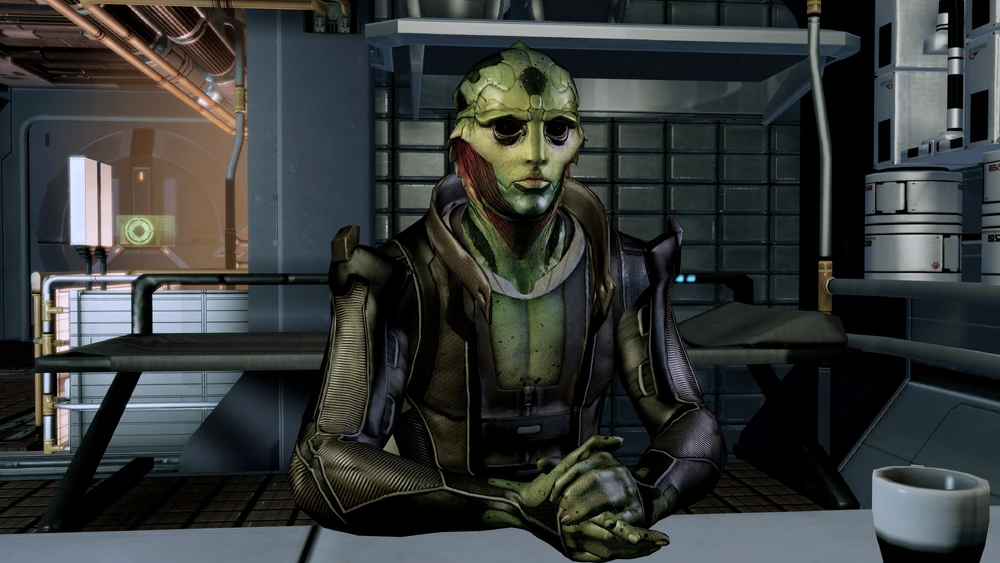
Even in the world of video games, where one can play as the second love of a widower, the problem persists. BioWare games, in particular, have no shortage of sad handsome widowers ready to be coaxed into loving again, and yet the player rarely has the option to express interest in their love interest’s deceased wife, to find out anything about her independent of the fact that she loved this particular man and is now dead. There’s no time set aside to come to terms with her existence and her death—and once the romance switch is flipped, any mention of her usually disappears in order to avoid provoking the player’s jealousy.
(In all fairness, BioWare games also have a few female love interests with dead husbands, plus a male love interest with a dead husband. I admire their efforts toward dead spouse egalitarianism.)
It’s easy to blame the problem on specific male writers, and talking shit about specific male writers is definitely a major hobby of mine, but I think the larger problem is how our culture decides whose stories matter, and whose don’t. Some characters are allowed to have a complex narrative surrounding death and bereavement, and others are only there to facilitate that narrative. And the characters that usually fall into either camp reveal our biases, conscious or not.
I’ve never read or watched or played any depiction of widowers and second loves that touched me as deeply as Yoffe’s essay, and I don’t think that’s because Yoffe’s essay is nonfiction. I think it’s because the fictional depictions fail to explore the depth, nuance, and emotional truth available to them. Which is a damn shame.
Leave a Reply